
Why Great Coaches Teach Skills Before Plays
Why Great Coaches Teach Skills Before Plays
The first article in The Win With The Pass Way series
Every offseason, coaches across the country gather in clinics, watch YouTube videos, and search the internet looking for the next great offensive idea.
They’re searching for a new formation, a better screen package, a clever red-zone concept, or the next wrinkle that will give them an advantage on Friday night.
I’ve been that coach.
For years, I believed the difference between winning and losing was finding the right play.
Then one day I realized I had been asking the wrong question.
The problem wasn’t our playbook.
The problem was our teaching.
My First Lesson
The summer after my senior year of high school, I reported to college football believing I understood the game.
I had played tight end and wide receiver. I loved football, worked hard, and considered myself a good athlete.
Within just a few weeks, I realized I knew far less than I thought.
Every step of every route mattered.
Every release had a purpose.
Every release was coached.
Everything was evaluated.
Every practice was intentionally designed to build skills that would eventually appear on game day.
Nothing was accidental.
I wasn’t suddenly bigger, stronger, or faster.
But after only a few weeks of college coaching, I went home and watched one of my former high school teams play.
It honestly felt like I was watching a different sport.
Not because my high school coaches didn’t care.
They cared deeply.
They loved kids.
They invested countless hours.
But they had mostly taught us plays.
My college coaches taught us football.
That distinction changed the way I viewed coaching forever.
The Mistake Most Coaches Make
Most offenses are organized around plays.
Practice becomes a rehearsal of assignments.
Players memorize where to line up.
They memorize motions.
They memorize routes.
They memorize blocking schemes.
Then we hope execution follows.
Sometimes it does.
Often it doesn’t.
Why?
Because players haven’t developed the skills required to execute those assignments consistently.
Imagine drawing the perfect slant concept on the whiteboard.
The quarterback knows where to throw the football.
The receiver knows where to run.
But ask yourself:
- Has the receiver learned how to release against press coverage?
- Does he know how to stem a defender?
- Can he create separation at the top of the route?
- Has he caught that exact ball hundreds of times?
- Has the quarterback mastered the footwork that matches the timing of the route?
If the answer is “no,” the play doesn’t fail because the concept is bad.
It fails because the skills behind the concept haven’t been developed.
Great coaches understand that difference.
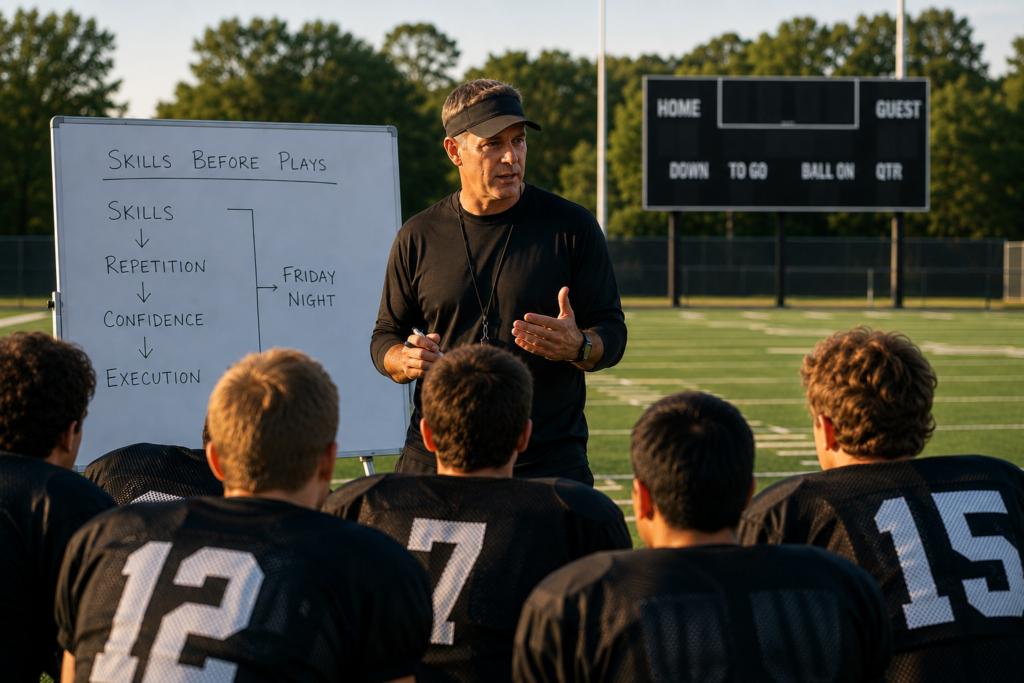
Teach Skills Before Plays
One of the foundational beliefs of The Win With The Pass Way is simple:
Teach skills before plays.
Every play is simply a collection of individual skills working together.
If those skills improve, execution improves.
If execution improves, confidence grows.
If confidence grows, players begin playing faster, making better decisions, and enjoying the game more.
The playbook hasn’t changed.
The players have.
Practice Is a Classroom
This realization completely changed the way I designed practice.
Instead of asking,
“What plays should we run today?”
I started asking,
“What skills do our players need in order to execute our offense?”
That single question transformed everything.
Quarterbacks practiced footwork before progressions.
Receivers learned releases before route combinations.
Linemen mastered pass protection before worrying about exotic blitz packages.
Every drill existed for one reason:
To teach an essential skill that would eventually appear on Friday night.
If a drill didn’t build an essential skill, we eliminated it.
Every minute had to matter.
Repetition With Purpose
People often ask why we practice so fast.
The answer isn’t because I want to play fast on Friday night.
That’s certainly a benefit.
The real reason is much simpler.
I want more meaningful repetitions.
Repetition without purpose is just activity.
Purposeful repetition builds confidence.
The more quality repetitions players accumulate, the more prepared they become.
Preparation produces confidence.
Confidence produces better decisions.
Better decisions produce better football.
That’s why our practices often feel faster than our games.
By Friday night, our players aren’t trying something new.
They’re simply repeating something they’ve already done hundreds of times.
The Coach’s Job
I’ve come to believe the coach’s primary responsibility isn’t calling plays.
It’s designing learning.
Great coaches remove complexity before adding it.
They teach understanding before expecting execution.
They create environments where players experience success through preparation rather than hope.
That’s what great teachers do.
And great coaches are great teachers.
Beyond Football
This principle extends far beyond football.
Great teachers don’t begin with the final exam.
They build the underlying skills necessary for students to succeed.
Great business leaders don’t expect excellence without first creating clarity, practice, and feedback.
Great parents don’t simply tell their children what to do.
They patiently teach them how to think, make decisions, and grow.
Football simply gives us one of the greatest classrooms for practicing those lessons.
The Win With The Pass Reflection
Before your next practice, take out your practice plan.
Beside every drill, write down the essential skill it is designed to develop.
Then ask yourself these three questions:
- Am I teaching skills or merely rehearsing plays?
- Which drill has the clearest developmental purpose?
- What is one change I can make tomorrow that gives my players more meaningful repetitions?
You may discover that your practice isn’t actually teaching football.
It’s simply rehearsing assignments.
When that happens, don’t start by changing your playbook.
Start by changing your teaching.
Because great offenses are rarely built on great plays.
They are built on players who have mastered the skills behind them.
This article is part of The Win With The Pass Way—a philosophy of formational coaching that helps coaches teach with clarity, practice with purpose, lead with intention, and form young people through the game of football.
